The Best Cities to Live in Bulgaria Compared

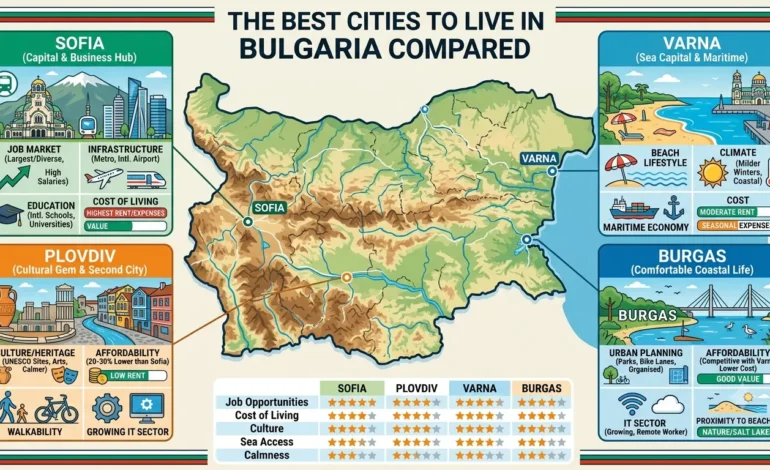
A comprehensive guide for expats, digital nomads, retirees, families, and anyone considering a move to one of Europe’s most underrated destinations.
Why Bulgaria, and Why Does City Choice Matter?
Few countries in Europe offer the combination of factors that Bulgaria quietly delivers: EU membership with significantly lower costs than Western Europe, a surprisingly sophisticated digital infrastructure, dramatic natural landscapes ranging from Black Sea beaches to alpine ski resorts, and a cultural heritage stretching back thousands of years. In recent years, Bulgaria has attracted a growing wave of remote workers, retirees seeking affordability, entrepreneurs drawn by low corporate taxes, and expats simply looking for a slower, more meaningful pace of life.
Yet Bulgaria is not a monolith. The country that reveals itself in Sofia’s glass-and-steel startup districts looks entirely different from the cobblestone lanes of Plovdiv’s old town, the salt-tinged air of Varna’s beachfront boulevard, or the riverside promenades of Ruse. Each city has its own economic character, social rhythm, and quality of life profile. Choosing the wrong city—or rather, choosing a city that doesn’t match your personal priorities—can mean the difference between a deeply satisfying relocation and a frustrating experience.
This article compares Bulgaria’s most significant urban centers across every dimension that matters: cost of living, job opportunities, healthcare, climate, community, and long-term livability. The cities covered in depth include Sofia, Plovdiv, Varna, Burgas, Ruse, Veliko Tarnovo, and Stara Zagora, with shorter profiles of several smaller cities worth considering. Rather than producing a simple ranked list, this guide helps you determine which city best fits your particular lifestyle, career stage, budget, and personal values.
What Makes a City Great to Live In?
Before comparing destinations, it’s worth establishing what “livability” actually means—because it means different things to different people. A digital nomad prioritizes fiber internet and coworking spaces. A retiree cares deeply about healthcare access and tranquility. A family weighs school quality and green spaces. An entrepreneur wants a business-friendly regulatory environment and access to talent.
The criteria used throughout this article include:
- Cost of living: Monthly expenses for rent, utilities, groceries, transport, and leisure
- Housing affordability: Both rental and purchase markets
- Job market: Local employment opportunities, dominant industries, average salaries
- Internet quality: Speed, reliability, and coverage—critical for remote workers
- Public transport: Coverage, reliability, and integration
- Walkability: How much of daily life can be managed on foot
- Safety: Crime rates and general sense of personal security
- Healthcare: Hospital quality, specialist availability, English-language access
- Education: International schools, university presence, and public school quality
- International community: Expat networks, English proficiency, international services
- Climate: Temperature ranges, sunshine hours, seasonal variation
- Green spaces and nature access: Parks, trails, and proximity to natural areas
- Entertainment and nightlife: Restaurants, bars, cultural events
- Family friendliness: Infrastructure, pace of life, community feel
- Business environment: Bureaucracy, taxes, support ecosystems
- Long-term growth potential: Infrastructure investment, demographic trends, EU funding
No city scores perfectly across all of these. The “best” city is always the one that scores highest on your personal list of priorities.
Sofia – Bulgaria’s Dynamic Capital
Character and First Impressions
Sofia is a city that doesn’t immediately reveal its charms. Arriving from Western Europe, visitors may notice the Soviet-era apartment blocks, heavy traffic, and grey Soviet-influenced boulevards before they notice the snowcapped peak of Vitosha Mountain rising immediately to the south of the city center, the elegant pedestrian boulevard lined with lime trees, or the surprising density of Orthodox churches tucked between modernist office towers. But spend a week here, and Sofia’s energy becomes unmistakable.
With a population of approximately 1.2 to 1.3 million (metropolitan area), Sofia is by far Bulgaria’s largest city. It is home to the country’s political, economic, and cultural institutions, the largest concentration of multinational companies, and the most developed digital infrastructure in Bulgaria.
Economy and Employment
Sofia dominates Bulgaria’s economy. The IT sector has grown explosively over the past decade, making Sofia one of Central and Eastern Europe’s emerging tech hubs. Companies like SAP, Hewlett Packard Enterprise, VMware, and dozens of mid-size software firms maintain significant operations in the capital. The city’s startup ecosystem, while still maturing compared to Warsaw or Bucharest, has produced notable companies in fintech, SaaS, and e-commerce.
Average monthly salaries in Sofia are the highest in Bulgaria, typically ranging from approximately BGN 2,000 to 4,000 (€1,000–2,000) for skilled professionals in IT, finance, and management. For Bulgarian standards, this is substantial purchasing power, though it remains modest compared to Western European equivalents.
Digital Infrastructure and Coworking
Bulgaria consistently ranks among Europe’s fastest internet countries by average connection speed. Sofia has the most developed coworking infrastructure in the country, with spaces including Campus X, Puzl CowOrKing, and numerous smaller venues catering to freelancers and startup teams. Fiber optic broadband is widely available, and mobile 4G/5G coverage is excellent across the city.
Neighborhoods Worth Knowing
- Lozenets and Iztok: Upscale residential neighborhoods popular with expats and professionals; tree-lined streets, international restaurants, higher rents
- Oborishte: Central, walkable, mix of old and new, close to cultural institutions
- Mladost: More modern, home to Business Park Sofia and many IT company offices; practical but less characterful
- Boyana and Dragalevtsi: Quiet suburbs near Vitosha, popular with families; excellent air quality by Sofia standards
- Lyulin and Nadezhda: More affordable working-class districts; functional but less attractive to international residents
Housing Market
Sofia’s rental market has tightened significantly over the past five years, driven by population growth, increased tech-sector salaries, and investment in short-term rental platforms. A one-bedroom apartment in a desirable central neighborhood now typically rents for BGN 1,000–1,600/month (€500–800), while a two-bedroom family apartment in Lozenets or Iztok may reach BGN 1,800–2,500/month (€900–1,250).
Property purchase prices have risen sharply. In prime central areas, prices of €1,500–2,500 per square meter are now common, approaching levels that undermine the “cheap Eastern European property” narrative. However, outer districts and suburbs remain more affordable.
Public Transport and Mobility
Sofia has an expanding metro system (three lines as of 2024, with extensions underway), a dense tram and trolleybus network, and extensive bus coverage. The metro is generally clean, punctual, and affordable. However, Sofia also has one of the worst traffic congestion problems in Southeast Europe. Driving in central Sofia during peak hours is a frustrating exercise; cycling infrastructure, while improving, remains limited. Many expats choose to live centrally and rely on the metro and walking.
Air Quality and Environment
Sofia’s air quality is a genuine concern. Located in a basin surrounded by mountains, the city traps pollution, particularly from wood burning and old diesel vehicles during winter months. Air quality regularly ranks among the worst in the EU during cold periods. This is not a trivial consideration for families with children or individuals with respiratory issues. Summer air quality is significantly better, and proximity to Vitosha provides access to genuinely clean mountain air within a 30-minute drive.
Cultural Life and Lifestyle
Sofia punches above its weight culturally. The National Theatre, National Opera, National History Museum, Sofia Philharmonic, numerous art galleries, and an increasingly vibrant independent music and arts scene give the capital genuine cultural depth. The restaurant scene is diverse, with quality options spanning Bulgarian traditional cooking, Japanese, Indian, Middle Eastern, and pan-European cuisines. Nightlife is lively, particularly in the student-heavy district of Studentski Grad and around the NDK (National Palace of Culture).
Who Sofia Is Best For
Sofia is the clear choice for career-focused professionals, particularly in IT, finance, consulting, and business development. It is the only Bulgarian city with a genuinely international job market. Entrepreneurs benefit from the concentration of talent, capital, and professional services. Students find the largest selection of universities and programs. Digital nomads who want urban energy alongside coworking options will feel at home. The city is harder to recommend for those prioritizing air quality, tranquility, or a tight-knit community feel.
Plovdiv – Bulgaria’s Cultural Capital
Character and Appeal
If Sofia is Bulgaria’s engine, Plovdiv is its soul. Bulgaria’s second-largest city (population approximately 350,000–380,000) has been inhabited continuously for more than 8,000 years, making it one of the oldest cities in Europe. The ancient Thracians, Romans, Byzantines, and Ottomans all left their marks on this city built across seven hills—a fact that locals are rightly proud of. Plovdiv served as the European Capital of Culture in 2019, a designation that accelerated an already-underway transformation of its creative and hospitality scene.
Walking through the Old Town—known as Kapana (literally “the trap,” referring to its winding streets)—feels like inhabiting a living museum. Roman amphitheaters and ancient fortifications sit alongside bohemian cafés, independent galleries, boutique hotels, and artisan workshops. The atmosphere is relaxed in a way that Sofia simply isn’t.
Quality of Life
Plovdiv offers what many expats and relocators describe as an ideal balance: it is large enough to offer genuine urban amenities—a functioning healthcare system, universities, international restaurants, a growing co-working scene—while small enough to feel human-scaled and walkable. The Old Town and the adjacent Kapana creative district are genuinely pleasant to explore on foot, without Sofia’s traffic or pollution. Plovdiv’s air quality, while not perfect, is meaningfully better than the capital’s.
The city has a growing expat and creative community. Artists, writers, architects, and freelancers from across Europe have been drawn by affordable rents (though these have risen since 2019), the city’s aesthetic beauty, and its cultural vitality. English proficiency is growing, particularly among younger residents.
Economy and Cost of Living
Plovdiv is Bulgaria’s second economic center, with strengths in manufacturing (particularly food processing, chemicals, and electronics), trade, and an expanding services sector. The University of Plovdiv and the Medical University contribute to the city’s academic and intellectual atmosphere. However, Plovdiv’s job market is smaller and more limited than Sofia’s, particularly in tech and international business. Those dependent on a local Bulgarian salary will find wages somewhat lower than the capital.
The cost of living is meaningfully lower than Sofia. Rent for a one-bedroom in a desirable central area typically runs BGN 600–1,000/month (€300–500). A comfortable two-bedroom in a quieter residential neighborhood may cost BGN 700–900/month. Groceries, dining, and entertainment are all priced lower than Sofia on average, making Plovdiv an attractive base for remote workers earning foreign salaries.
Housing and Neighborhoods
The Old Town and Kapana are expensive by Plovdiv standards and sometimes impractical for daily living (parking is difficult, buildings are old, and renovation standards vary). More practical neighborhoods for actual residents include Trakiya (a large modern district with good amenities), Kamenitsa, and the areas around the central Kapana hub. New construction developments on the outskirts offer modern apartments at competitive prices.
Who Plovdiv Is Best For
Plovdiv consistently ranks as one of the most recommended cities in Bulgaria for digital nomads and remote workers who value atmosphere and culture over career advancement. Creative professionals, artists, and writers are naturally drawn to the city’s artistic energy. Retirees who want an aesthetically beautiful, walkable environment without Sofia’s hustle find Plovdiv deeply appealing. Couples and young families who don’t depend on a large local job market and want a relaxed, culturally rich lifestyle frequently choose Plovdiv over the capital.
Section 4: Varna – Coastal Living with Urban Comforts
Character and Location
Varna is Bulgaria’s third-largest city (population approximately 330,000–350,000) and its primary port on the Black Sea. It has a distinctly different energy from both Sofia and Plovdiv—more laid-back, more resort-inflected, and unmistakably oriented toward the sea. The city’s famous Sea Garden, one of the largest seaside parks in the Balkans, stretches along the coast and serves as Varna’s social heart, especially in summer.
The city has been inhabited since antiquity—the Varna Gold, discovered in a local necropolis and dating to approximately 4,600–4,200 BC, is considered the oldest worked gold in the world. The city’s Archaeological Museum houses one of Bulgaria’s most impressive collections.
Summer vs. Winter
Varna’s character shifts dramatically by season, and this is arguably the most important thing to understand about living there. From May through September, the city is vibrant, busy, and international. The beaches are well-maintained. The restaurant terraces are full. A lively mix of Bulgarian tourists, international visitors, and local residents creates genuine energy along the seaside boulevard.
From October through April, Varna quiets significantly. Some restaurants and venues close or reduce hours. The streets empty of tourists. For those who enjoy a quieter pace of life, this off-season can be genuinely pleasant—prices drop, the city belongs more fully to its residents, and the Black Sea in winter is strikingly beautiful. But those who moved for beach lifestyle may find the winters unexpectedly subdued.
Economy and Employment
Varna’s economy is built around maritime trade, shipbuilding, tourism, and a growing IT sector. The city hosts several universities including the Technical University of Varna, Varna Free University, and the Medical University. IT companies have been expanding their presence in Varna, drawn by lower real estate costs than Sofia and access to a university-educated workforce.
Average salaries are lower than Sofia but comparable to Plovdiv. The local job market is more limited than the capital’s, making Varna most practical for remote workers, those with location-independent income, or individuals working in maritime or tourism sectors.
Housing and Cost of Living
Varna’s housing market reflects its resort-city character. Centrally located apartments near the Sea Garden command premium prices, particularly during summer. Rents for a one-bedroom near the center or sea start at around BGN 700–1,000/month (€350–500) and rise significantly for quality sea-view units. Further from the center, more affordable options exist. Property prices have been rising, driven partly by investor interest in the tourist market.
Overall cost of living is comparable to Plovdiv—lower than Sofia, but with the caveat that utility costs (air conditioning in summer, heating in shoulder seasons) can be higher than in inland cities.
Healthcare and Infrastructure
Varna has two significant hospitals and better specialist coverage than most Bulgarian cities outside Sofia. The city’s port status means it has historically had better international connectivity than some inland cities.
Who Varna Is Best For
Varna is ideal for beach lovers and water sports enthusiasts who want urban amenities alongside seaside lifestyle. Digital nomads and remote workers who want sun, sea, and reasonable infrastructure without Sofia’s congestion find it compelling. Maritime industry professionals will find the most relevant local job market here. Students have access to several strong universities. Those who find the winter slowdown unappealing may be disappointed, but Varna residents who understand and embrace the seasonal rhythm often describe it as their favorite feature.
Burgas – Relaxed Coastal Lifestyle
Character and Atmosphere
Often overshadowed by its larger neighbor Varna, Burgas (population approximately 200,000) is Bulgaria’s fourth-largest city and offers a distinctly more relaxed coastal experience. The city sits on a peninsula bordered by the Black Sea, salt lakes, and wetlands that together create an unusual natural environment. The Burgas Lakes are internationally recognized for bird migration, and the city has a genuine eco-tourism dimension that Varna lacks.
Burgas has invested heavily in its waterfront and central pedestrian zones over the past decade, creating an appealing public realm for an unpretentious city. The pace of life is noticeably slower than Sofia or Varna, which is a deliberate attraction for many residents rather than a drawback.
Family Friendliness and Safety
Burgas is widely regarded as one of Bulgaria’s most family-friendly cities. Crime rates are low even by Bulgarian standards. The city is walkable, the traffic is manageable, and the natural environment—beaches, parks, lakes, and wetlands all within easy reach—provides an excellent backdrop for families with children.
Economy and Infrastructure
Burgas’s economy is based primarily on tourism, trade, port activities, and petrochemical industry (there is a significant refinery nearby). The city has an international airport with connections to several European destinations, particularly useful during summer months. Employment opportunities are more limited than in Sofia or Varna, making Burgas most practical for those with remote income or retirement savings.
Cost of Living and Housing
Burgas is one of the more affordable larger cities in Bulgaria. Rents are generally lower than Varna for comparable properties, and property prices, while rising, remain accessible. A one-bedroom apartment in a decent area typically rents for BGN 500–800/month (€250–400).
Who Burgas Is Best For
Retirees seeking a calm, pleasant coastal environment will find Burgas extremely appealing. Young families who prioritize safety, outdoor space, and a manageable urban environment should consider it seriously. Remote workers who value tranquility over urban energy may prefer Burgas’s pace to Varna’s busier character.
Ruse – Bulgaria’s “Little Vienna”
Character and Location
Ruse (population approximately 130,000–140,000) occupies a unique position in Bulgaria—both geographically and culturally. Situated on the Danube River and directly connected by bridge to Giurgiu in Romania, Ruse developed in the 19th century as one of Bulgaria’s most cosmopolitan cities, absorbing Austro-Hungarian architectural influences that give its center an unusual elegance for a Bulgarian provincial city. The comparison to Vienna is an exaggeration, but the point stands: Ruse’s neoclassical and Baroque-influenced architecture genuinely distinguishes it.
The city’s riverside setting is beautiful, particularly along the main boulevard and the Danube riverside areas. The cultural institutions—a philharmonic orchestra, theater, opera, several museums—are impressive for a city of this size.
Economy and Connectivity
Ruse’s economy includes manufacturing, trade, and logistics, benefiting from its position as a key Danube crossing point and transport corridor. The University of Ruse contributes an academic dimension. Salaries and employment opportunities are limited compared to Sofia, and the city has experienced population decline over recent decades—a structural challenge facing many of Bulgaria’s mid-sized cities.
Cross-border proximity to Romania is an interesting dimension. Bucharest is approximately two hours by car, offering access to a much larger labor market, international airport, and metropolitan services. Some residents actively leverage this dual-city dynamic.
Cost of Living
Ruse is one of Bulgaria’s more affordable cities. Rents for a one-bedroom apartment in a reasonable neighborhood typically start at BGN 350–600/month (€175–300). Property purchase prices are low by Bulgarian standards, making it interesting for investors or those seeking affordable homeownership.
Lifestyle
Ruse has a quieter, more contemplative pace of life. The cultural life is surprisingly rich for the city’s size. However, nightlife and entertainment options are limited compared to Sofia, Plovdiv, or Varna, and the international community is minimal. English proficiency is lower here than in the larger cities.
Who Ruse Is Best For
Budget-conscious retirees who value cultural atmosphere over urban energy will find Ruse charming. History and architecture enthusiasts will appreciate the city’s distinctive character. Remote workers seeking very affordable rents and a quiet lifestyle may find it suits them, though the lack of expat community and limited English proficiency should be weighed carefully.
Veliko Tarnovo – Historic Beauty and Student Life
Character and Setting
Veliko Tarnovo (population approximately 65,000–70,000) is one of Bulgaria’s most visually spectacular cities. Built across dramatic hills above the Yantra River gorge, with the medieval Tsarevets Fortress dominating the skyline, Veliko Tarnovo was the capital of the Second Bulgarian Empire (1185–1393) and occupies a central place in Bulgarian national identity.
The city’s setting—steep, winding streets, dramatic cliffside views, the fortress rising above the river—creates an atmosphere unlike anywhere else in Bulgaria. The aesthetic experience of daily life here is genuinely beautiful.
Student Population and Energy
Veliko Tarnovo University (St. Cyril and St. Methodius University) is one of Bulgaria’s most respected humanities institutions, giving the small city a disproportionately large student population that drives a lively café culture, entertainment scene, and affordable dining options. The ratio of students to permanent residents keeps the city feeling youthful and energetic even though it is small by urban standards.
Tourism and Economy
Tourism is central to the local economy, which creates a service infrastructure (restaurants, guesthouses, tour operators) that benefits residents as well as visitors. However, the economic base is narrow, and employment opportunities beyond tourism, education, and the public sector are limited. Salaries are among the lower averages in Bulgaria.
Outdoor Activities
The surrounding region offers excellent hiking, cycling, and exploration of smaller medieval villages and monasteries. The Arbanasi village (immediately adjacent to Veliko Tarnovo) is a popular destination for expats seeking rural character near a town with basic amenities.
Who Veliko Tarnovo Is Best For
Retirees and lifestyle migrants who prioritize historical beauty and a relaxed pace over economic opportunity find Veliko Tarnovo deeply compelling. Writers, artists, and academics drawn by the city’s intellectual and historical character are well-served. Budget travelers considering longer stays often discover that the city’s atmosphere makes it hard to leave. It is less suitable for those who require a robust job market or modern urban infrastructure.
Stara Zagora – An Underrated Choice
Character and Infrastructure
Stara Zagora (population approximately 130,000–140,000) is one of Bulgaria’s most systematically planned cities—rebuilt on a grid after a devastating fire in 1877 during the Russo-Turkish War—and one of its most underappreciated. The wide boulevards, well-maintained parks, and orderly urban layout give it a more livable, less chaotic character than cities that grew more organically.
The city sits in the Thracian Plain with a generally mild climate, excellent central location (roughly equidistant from Sofia, Plovdiv, the Black Sea coast, and the Rhodope Mountains), and surprisingly strong industrial and economic base.
Economy and Employment
Stara Zagora is home to some of Bulgaria’s most significant industrial enterprises, including the Maritsa East coal-mining and energy complex (though this sector faces long-term structural challenges given EU energy transition policies), agricultural processing, and brewing (home of Zagorka, one of Bulgaria’s most popular beers). The city has a Medical University and a Technical University, giving it academic depth.
Salaries and employment opportunities are more varied here than in smaller provincial cities, though still well below Sofia.
Livability
Stara Zagora has an unusually high density of parks for a Bulgarian city of its size. The central park system and the pedestrian zones make it comfortable for walking and family life. Healthcare facilities are genuinely strong for a city this size, partly driven by the Medical University presence. The cost of living is low—rents for a one-bedroom apartment start around BGN 350–550/month (€175–275).
Who Stara Zagora Is Best For
Families seeking affordable living with solid infrastructure will find Stara Zagora quietly impressive. Remote workers who need a functional, affordable base without metropolitan stress may discover it suits them better than better-known alternatives. It deserves more attention from those researching Bulgarian cities.
Smaller Cities Worth Considering
Blagoevgrad
Located in the foothills of the Rila and Pirin mountains, Blagoevgrad (population ~65,000) is home to the American University in Bulgaria, which gives it an unusual international character for its size. English proficiency is higher here than in most comparable Bulgarian towns, and the American University community creates a small but genuine expat presence. Excellent access to Bansko ski resort (about 60 km) and proximity to Greece (Thessaloniki is under two hours away) are practical advantages.
Dobrich
The regional center of northeastern Bulgaria, Dobrich (~85,000) serves the agriculturally productive Dobrudzha region. It is quiet, affordable, and functional, though with limited cultural life and a small expat community. Proximity to Varna (about 60 km) allows residents to access coastal amenities without paying coastal prices.
Sandanski
Located in the Struma River valley with a famously mild climate (among the most sun-blessed locations in Bulgaria), Sandanski (~25,000) has long been a health resort destination, particularly for those with respiratory conditions. The town is small but pleasant, extremely affordable, and close to the Greek border and the Pirin Mountains. It is gaining attention among retirees seeking warm, affordable winters.
Bansko
Though technically a small town (~8,000 permanent residents), Bansko deserves mention as a popular base for digital nomads and winter sports enthusiasts. Bulgaria’s premier ski resort has developed a genuine nomad community, with coworking spaces, international restaurants, and a reliable English-speaking hospitality infrastructure that is unusual for a mountain town. Winters are cold and snowy (a feature for ski enthusiasts, a concern for others).
Gabrovo
A small city in the Balkan Mountains known for its traditional crafts, industrial heritage, and a Museum of Humor and Satire that reflects the city’s distinctive character. Gabrovo is exceptionally affordable but has a declining population and limited employment. Suitable for those seeking an authentic Bulgarian small-city experience at minimal cost.
Shumen
A mid-sized city (~80,000) in northeastern Bulgaria with a strong musical and cultural tradition. The Shumen Plateau and nearby Madara Horseman (a UNESCO World Heritage Site) provide interesting context. Affordable and functional, though limited economically.
Comparing the Cities
Cost of Living and Housing Comparison
| City | 1BR Rent (Center) | 2BR Rent (City) | Average Salary | Relative Cost of Living |
|---|---|---|---|---|
| Sofia | €500–800/mo | €700–1,100/mo | €1,000–1,500 | ★★★☆☆ (moderate for Bulgaria) |
| Plovdiv | €300–500/mo | €400–700/mo | €700–1,000 | ★★☆☆☆ (affordable) |
| Varna | €350–500/mo | €450–750/mo | €700–1,000 | ★★☆☆☆ (affordable) |
| Burgas | €250–400/mo | €350–600/mo | €650–900 | ★★☆☆☆ (affordable) |
| Ruse | €175–300/mo | €250–450/mo | €600–850 | ★☆☆☆☆ (very affordable) |
| Veliko Tarnovo | €150–280/mo | €200–400/mo | €550–750 | ★☆☆☆☆ (very affordable) |
| Stara Zagora | €175–275/mo | €250–400/mo | €650–900 | ★☆☆☆☆ (very affordable) |
Note: Figures are indicative ranges based on 2023–2024 market data. BGN figures converted at approximately BGN 2 = €1.
Livability Factor Comparison
| Category | Sofia | Plovdiv | Varna | Burgas | Ruse | Vel. Tarnovo | Stara Zagora |
|---|---|---|---|---|---|---|---|
| Job Market | ★★★★★ | ★★★☆☆ | ★★★☆☆ | ★★☆☆☆ | ★★☆☆☆ | ★★☆☆☆ | ★★☆☆☆ |
| Internet Quality | ★★★★★ | ★★★★☆ | ★★★★☆ | ★★★☆☆ | ★★★☆☆ | ★★★☆☆ | ★★★☆☆ |
| Public Transport | ★★★★☆ | ★★★☆☆ | ★★★☆☆ | ★★☆☆☆ | ★★☆☆☆ | ★★☆☆☆ | ★★☆☆☆ |
| Healthcare | ★★★★☆ | ★★★☆☆ | ★★★★☆ | ★★★☆☆ | ★★☆☆☆ | ★★☆☆☆ | ★★★☆☆ |
| Cultural Life | ★★★★★ | ★★★★★ | ★★★★☆ | ★★★☆☆ | ★★★☆☆ | ★★★☆☆ | ★★☆☆☆ |
| Air Quality | ★★☆☆☆ | ★★★☆☆ | ★★★★☆ | ★★★★☆ | ★★★☆☆ | ★★★★☆ | ★★★☆☆ |
| Safety | ★★★☆☆ | ★★★★☆ | ★★★☆☆ | ★★★★☆ | ★★★★☆ | ★★★★☆ | ★★★★☆ |
| Walkability | ★★★☆☆ | ★★★★☆ | ★★★☆☆ | ★★★☆☆ | ★★★★☆ | ★★★★☆ | ★★★★☆ |
| Nature Access | ★★★☆☆ | ★★★☆☆ | ★★★★☆ | ★★★★★ | ★★★☆☆ | ★★★★☆ | ★★★☆☆ |
| Expat Community | ★★★★★ | ★★★★☆ | ★★★★☆ | ★★☆☆☆ | ★★☆☆☆ | ★★☆☆☆ | ★★☆☆☆ |
| Family Friendly | ★★★☆☆ | ★★★★☆ | ★★★★☆ | ★★★★★ | ★★★★☆ | ★★★★☆ | ★★★★☆ |
| Nightlife | ★★★★★ | ★★★★☆ | ★★★★☆ | ★★☆☆☆ | ★★☆☆☆ | ★★☆☆☆ | ★★☆☆☆ |
Which City Is Best For…
Digital Nomads and Remote Workers
Primary recommendation: Plovdiv — The combination of affordable rents, excellent walkable atmosphere, growing coworking infrastructure, cultural richness, and lower cost of living than Sofia makes Plovdiv the most compelling all-around choice for location-independent workers who want more from their city than just desk space.
Strong alternative: Sofia — For those who want the largest coworking ecosystem, the most diverse restaurant and social scene, and the most reliable infrastructure, Sofia remains the benchmark. Bansko deserves mention for those who want mountain lifestyle and have found the nomad community there.
Varna is the obvious choice for those specifically seeking beach-plus-internet lifestyle, with the understanding that winter months are significantly quieter.
Entrepreneurs and Business Owners
Sofia is the only realistic choice for those building a business that requires local talent, investor access, professional services, or supply chain logistics. The capital has the largest concentration of accountants, lawyers, marketing agencies, recruiting firms, and business advisors with international experience. Bulgaria’s flat 10% corporate tax rate and low personal income tax apply nationwide, but the practical infrastructure for running a business is concentrated in Sofia.
Families with Children
Burgas and Plovdiv both score highly for families. Burgas offers the cleanest environment (air quality, safety, access to beaches and nature), while Plovdiv offers more cultural stimulation and a larger city with better school choices. Sofia has the most international school options—including American, British, and French schools—making it the default for families requiring English-medium education.
Retirees
Sandanski, Plovdiv, and Burgas emerge as the strongest options. Sandanski’s exceptional climate (mild winters, abundant sunshine) is genuinely therapeutic. Plovdiv offers cultural depth and beautiful urban character without metropolitan stress. Burgas balances coastal lifestyle with calm, safety, and affordability. Ruse and Veliko Tarnovo suit those who find historic architectural beauty more important than modern amenities.
Students
Sofia offers the largest range of universities and programs. Plovdiv (University of Plovdiv, Medical University of Plovdiv) and Varna (Technical University, Varna Free University, Medical University) are strong alternatives in their fields. Blagoevgrad is unique for those considering the American University in Bulgaria, which teaches entirely in English.
Budget-Conscious Expats
Veliko Tarnovo, Ruse, Gabrovo, and Stara Zagora offer the lowest costs of living in cities with reasonable amenities. Monthly expenses (rent, food, utilities, transport) of €600–900 are achievable in these cities for a comfortable lifestyle—figures that would be impossible in Western Europe and difficult even in Sofia.
Beach Lovers
Varna for those who want beach lifestyle within a genuine city. Burgas for those who want calmer coastal life. The numerous smaller coastal towns north and south of Varna and Burgas (Sozopol, Nesebar, Balchik) offer more intense seaside immersion at the cost of urban amenities.
Nature Lovers and Mountain Enthusiasts
Bansko (Pirin Mountains) and Blagoevgrad (Rila and Pirin access) for winter sports and year-round mountain activities. Smolyan in the Rhodopes for those seeking dramatic highland landscapes. Veliko Tarnovo for those who want accessible hiking without full mountain immersion.
Career-Focused Professionals
Sofia, unambiguously. For anyone relying on a local Bulgarian salary in a professional field, the capital pays significantly more and offers the widest range of opportunities. The gap is particularly pronounced in IT, finance, consulting, law, and media.
Common Mistakes When Choosing a Bulgarian City
Choosing Based Only on Rent
Rent is the most immediately visible cost comparison, but it’s incomplete. A city with €250/month rent may have poor healthcare access, no international community, limited cultural life, and few practical services. For many expats, the true cost of living in a city with poor services includes expensive private healthcare, frequent travel to larger cities, and social isolation—costs that don’t appear on rent comparison charts.
Ignoring Winter Weather
Bulgaria has genuinely cold winters across most of the country. Plovdiv, Sofia, Stara Zagora, and inland cities regularly see temperatures below 0°C from December through February, and snowfall is common. The Black Sea coast is somewhat milder, but still cold and windy. Many people fall in love with Bulgarian cities in summer and overlook how different the experience is from November through March. If possible, visit your chosen city in January before committing to relocation.
Overlooking Bulgarian Bureaucracy
Bulgaria’s bureaucratic processes for residence registration, business registration, and property purchase can be genuinely frustrating. The processes exist and are navigable, but they require patience, ideally a Bulgarian-speaking intermediary or lawyer, and realistic time expectations. Don’t assume that EU membership means the administrative experience resembles Germany or the Netherlands.
Underestimating Language Barriers
Bulgarian uses the Cyrillic alphabet and is linguistically challenging for English speakers. English proficiency has grown considerably among young urban Bulgarians, particularly in Sofia and Plovdiv, but in smaller cities and among older populations, getting by without Bulgarian is significantly harder. Administrative processes are conducted in Bulgarian. Medical consultations in provincial hospitals may require interpretation. This isn’t a reason to avoid Bulgaria, but it’s a reason to either invest in language learning or choose a city with a larger international community.
Assuming Every City Has the Same Job Market
The difference between Sofia’s job market and that of a city like Dobrich or Shumen is enormous. If you depend on local Bulgarian employment rather than remote income, your city choice is fundamentally constrained to Sofia (first choice), Plovdiv or Varna (second tier), and then a steep drop-off. Researching industry presence in a specific city before relocating for local employment is essential.
Judging Cities by Tourist Impressions
Visiting Varna in August or Plovdiv in spring gives a flattering picture that doesn’t fully represent year-round life. Conversely, Sofia in a grey February may seem more depressing than it is in summer. Try to visit potential cities across different seasons, stay in a residential neighborhood rather than a tourist hotel, shop at local markets, and use public transport.
Ignoring Infrastructure Variability
Internet speed, public transport quality, and healthcare access vary substantially between Bulgarian cities. Fiber internet is widely available in Sofia and Plovdiv; less so in smaller towns. Medical specialists are concentrated in larger cities. Public transport in cities without a metro system requires more planning and patience.
Future Outlook
Urban Development Trends
Bulgaria continues to benefit from substantial EU cohesion funds directed at infrastructure, public transport, environmental improvements, and urban regeneration. Sofia’s metro is being extended. Varna and Burgas are receiving waterfront and transport investment. Road connections between major cities have improved significantly over the past decade.
Real Estate Market Dynamics
Bulgaria’s property market has been on a sustained upward trajectory, particularly in Sofia, Plovdiv, and coastal cities. Rising incomes (partly driven by remote work), investor interest, and inflation-driven demand for hard assets have pushed prices meaningfully higher. The “cheap Bulgarian property” window has narrowed considerably in prime locations, though Bulgaria remains affordable by EU standards. Secondary cities and rural areas still offer genuinely low prices.
Remote Work and Expat Growth
Bulgaria’s attractiveness to digital nomads and remote workers continues to grow, supported by fast internet, low costs, and EU membership (which simplifies visa situations for EU citizens). Non-EU nationals face more complex visa situations but various digital nomad visa frameworks are worth researching. The trend is likely to continue accelerating, particularly if housing costs in Western European cities continue rising.
Population Trends and Challenges
Bulgaria faces long-term demographic challenges, including declining and aging population (driven partly by emigration to Western Europe). Several mid-sized and smaller cities have experienced population decline over recent decades. This affects the vitality of local economies and service provision in smaller centers—a factor worth considering for long-term relocation decisions. Sofia and, to a lesser extent, Plovdiv and Varna have bucked this trend with either stable or growing populations.
Which Cities Have Strongest Growth Potential
Sofia will continue to attract the largest share of investment, talent, and economic activity. Plovdiv is on a strong trajectory driven by the 2019 European Capital of Culture legacy, continued tourism growth, and its growing reputation among expats. Varna benefits from tourism investment and expanding tech presence. Stara Zagora and Ruse face structural challenges but have solid infrastructure that positions them well if they can attract investment.
The Right City for the Right Life
Bulgaria offers something that is increasingly rare in Europe: genuine affordability combined with EU membership, fast internet, diverse landscapes, and a deep cultural heritage. The country’s cities are not interchangeable—each has a distinct personality, economic profile, and quality of life proposition.
Sofia is where you go for career advancement, entrepreneurship, the largest expat community, and the most developed urban infrastructure—but you trade clean air, tranquility, and lower costs for those advantages. Plovdiv achieves an unusually satisfying balance between cultural richness, walkable beauty, and affordability, making it the most consistently recommended city for remote workers and lifestyle migrants. Varna delivers the beach lifestyle that draws so many people to Bulgaria, packaged within a real city with real amenities—if you understand and accept its seasonal rhythm. Burgas is the underrated choice for families and retirees who want coastal calm over coastal spectacle. Ruse and Veliko Tarnovo reward those who prioritize historical character, architectural beauty, and radical affordability over economic opportunity. Stara Zagora quietly delivers strong infrastructure and central location at minimal cost, deserving more attention than it typically receives.
The smaller cities—Sandanski’s sunshine, Blagoevgrad’s American University community, Bansko’s mountain-and-nomad combination—each serve specific niches better than the large cities can.
What no article can fully replace is personal experience. If you are seriously considering relocation to Bulgaria, visit your shortlisted cities in different seasons, connect with expat communities online (Facebook groups, expat forums), and talk to people who made the move before you. Bulgaria’s cities reveal themselves slowly and generously to those who approach them with patience and curiosity.
The best city in Bulgaria is not a fixed answer. It is the city that fits the life you want to live.
Disclaimer: Prices, infrastructure, and conditions change; always verify current information through recent sources and local contacts before making relocation decisions.